Hybrid tool + reportEvidence updated July 29, 2026CE marking machinery directive

CE marking machinery directive tool for AMR CE machinery directive 2006 42 EC routes

Use this CE marking machinery directive triage tool to decide whether an AMR drive unit is a component, partly completed machinery, safety component or complete machine, then see the CE marking machinery directive 2006/42/EC requirements route, transition date risk and evidence file expected by an OEM buyer.

AMR drive unit CE route calculator

Use the intended market form, safety claims, EU launch date and standards coverage to produce a route memo starting point.

Select AI/ML when obstacle avoidance, protective stop or speed limiting depends on self-evolving behavior.

Valid planning range: 2024-01-01 to 2032-12-31. The 20 January 2027 transition is evaluated automatically.

Route result appears here
1234Submit inputs to build the route memo
Minimum next action: keep the default partly completed machinery example, press Generate CE route, then compare the result with the manual classification table below if your supplier cannot confirm the route.
Route map
Classify productDate boundaryEvidence fileComponentPCM / DoIFull AMR CE20 Jan 2027 changes framework
Decision layer

What the result should change in your CE file

The calculator output is useful only if it changes buyer-facing evidence. These conclusions turn the tool output into the route memo, declaration pack and engineering actions an OEM usually needs.

The route depends on how the drive unit is placed on the market.

A motorized AMR drive unit sold only for integration is usually assessed as a component or partly completed machinery. A ready-to-use AMR or AGV needs the full machinery conformity route before CE marking.

Do not treat a CE label as the conformity assessment.

The defensible record is the classification decision, risk assessment, technical documentation, instructions, declaration type and the harmonised standards evidence behind those claims.

The 20 January 2027 boundary changes the framework for new EU placements.

For products first placed on the EU market before that date, Directive 2006/42/EC remains the main route. Products first placed on the market on or after that date need a Regulation (EU) 2023/1230 plan. Treat this as a strict cut-over for new placements, while checking Article 52 transitional provisions separately for already-placed machinery, existing certificates or stock-specific cases.

AI safety claims now need a machinery and AI Act watchlist.

Regulation (EU) 2023/1230 still treats fully or partially self-evolving machine-learning safety functions as a high-risk route. Regulation (EU) 2026/1744 adds AI Act alignment: delegated acts must add AI safety requirements to the machinery framework for application by 2 August 2028, and relevant AI Act standards or common specifications can support interim presumption-of-conformity planning.

Safety functions increase evidence burden even when classification is clear.

STO, SLS, protective stops and software-dependent safety behavior should be mapped to risk reduction claims. STO and SLS must meet specific PL/SIL targets (e.g., via IEC 61800-5-2) and tie into the overall AMR safety standard (ISO 3691-4).

Cybersecurity and software are now explicit safety components.

Under the new Regulation, protection against corruption is explicitly required. Software performing a safety function placed independently on the market is legally a safety component requiring its own CE marking. Safety-related control systems must be resilient against both accidental failures and intentional cyberattacks.

Substantial modifications transfer manufacturer responsibility.

Under Regulation (EU) 2023/1230, retrofitting an existing machine with an AMR drive or pushing a software update that changes safety behavior is a "substantial modification". The person making this change assumes full manufacturer obligations, including a new conformity assessment and CE marking.

Assessment method
1Classify2Date3Risk4Standards5File
StepDecisionOutput
1. ClassifyComponent, partly completed machinery, complete machine or safety component.Responsible economic operator and declaration type.
2. Date-boundFirst EU placing-on-market date before or after 20 January 2027.Directive 2006/42/EC route or Regulation (EU) 2023/1230 route.
3. Map risksHazards, safety functions and residual integration risks.EHSR checklist, ISO 12100 record and validation plan.
4. Match standardsHarmonised standards coverage is mapped, partial or unknown.Presumption-of-conformity evidence or standards-gap action list.
5. Compile fileDocumentation, labels, instructions and declarations are aligned.Technical file or integration evidence ready for distributor/OEM review.
Route boundaries by product form
ClassificationLikely routeCE mark treatmentEvidence to request
Drive unit componentSupplier evidence pack plus applicable LVD, EMC or RoHS declarations where relevant.Do not present it as Machinery Directive CE-marked unless it is independently placed on the market as machinery or a safety component.Bills of material, wiring limits, EMC/LVD test reports, integration manual and installation constraints.
Partly completed machineryDeclaration of Incorporation and assembly instructions under the machinery framework.No Machinery Directive CE mark for the partly completed machinery itself.Integration limits, residual risks, EHSR mapping, incomplete risk-reduction functions and assembly instructions.
Complete AMR or AGVFull conformity assessment, technical file, EU Declaration of Conformity and CE marking.CE mark can be affixed by the responsible manufacturer after the route is completed.ISO 12100 risk assessment, relevant robot/AMR standards as applicable, validation plan and user instructions.
Safety component or safety subsystemTreat the safety claim as part of the conformity route and verify whether third-party assessment is triggered.Avoid CE claims until the intended safety function, category and applicable framework are confirmed.Safety requirements specification, PL/SIL target, validation report, diagnostic coverage and software version control.
Directive vs Regulation decision table
Directivebefore 20 Jan 2027Regulationfrom 20 Jan 2027
TopicDirective 2006/42/ECRegulation 2023/1230Use in decision
Core frameworkDirective 2006/42/EC before the transition boundary.Regulation (EU) 2023/1230 for the post-transition route.Pick the framework from the planned EU placing-on-market date.
High-risk listsAnnex IV categories can trigger notified body involvement.Annex I Part A (mandatory Notified Body) and Part B reorganize high-risk categories and assessment routes.If your AMR drive uses machine learning or AI to ensure a safety function, it triggers Annex I Part A mandatory third-party assessment.
AI Act alignmentNo dedicated AI Act alignment mechanism.Regulation (EU) 2026/1744 adds delegated-act and standards alignment for high-risk AI systems in machinery.Track AI-safety claims separately from ordinary STO/SLS evidence and budget for 2028 delegated-act updates.
Digital instructionsInstructions generally must be provided in paper format to ensure immediate access by the operator.Digital instructions are allowed by default for professional B2B machinery. They must remain accessible online for the machine's expected lifetime and at least 10 years. A paper copy must be provided free of charge within one month if requested at purchase.Build a 10-year digital hosting plan, but retain print-on-demand capability for B2B buyers who invoke their right to paper.
Market documentsTechnical file, instructions and EU Declaration of Conformity or Declaration of Incorporation.Equivalent documentation discipline with updated terminology and economic-operator duties.Reuse evidence where valid, but update templates and legal references.
Cybersecurity & CorruptionNo explicit requirement for IT security to protect safety functions.Explicit mandate that cybersecurity threats must not compromise safety functions. Systems must withstand intentional cyberattacks.Include cyber-risk vectors in the risk assessment and provide evidence of protection (e.g., using ISO/TR 22100-4).
Software & ModificationsVague on standalone software and post-market retrofits.Defines software as a safety component. Formalizes "substantial modification": modifying safety logic or retrofitting transfers manufacturer duties.Treat major software updates and AMR retrofits as new conformity assessment triggers.
Enforcement & PenaltiesGoverned by older Member State frameworks with varied enforcement.Article 50 requires Member States to implement "effective, proportionate, and dissuasive" penalties by October 2026. Authorities can order removal from the market.Do not assume weak enforcement. Budget for strict compliance checks and potential product recalls if documentation is missing.
Risk signals and mitigations
LowMediumHighFix first
RiskSignalMitigationSeverity
Supplier sells a drive unit with a CE mark but no machinery route.Declaration only references EMC/LVD while buyer expects Machinery Directive coverage.Split component declarations from machinery conformity claims and add a route statement in quotations.High
Partly completed machinery is CE-marked as if it were complete machinery.No final AMR risk assessment, no final instructions and no end-use validation.Issue a Declaration of Incorporation and assembly instructions until final-machine conformity is complete.High
2027 transition is missed during a long OEM program.Pilot samples ship in 2026, but series production first reaches the EU after 20 January 2027.Run the tool with the first EU placing-on-market date, not the prototype date. Check Article 52 only for already-placed or certificate-specific cases, not as a launch grace period.Medium
Safety-function evidence is claimed but not validated or protected.STO/SLS appears in marketing copy without a PL/SIL target, ISO 3691-4/IEC 61800-5-2 mapping, or cybersecurity protection.Add a safety requirements specification, validation report, and cybersecurity measures against unauthorized access.High
AMR uses machine learning for obstacle avoidance and claims it as a safety function.Marketing promotes "AI-driven safety" without a Notified Body certificate under the new Regulation.Re-classify the system under Annex I Part A and budget for mandatory third-party conformity assessment, or use traditional deterministic logic (like a safety PLC) for the final protective stop.High
Ignoring cybersecurity in the safety risk assessment.Technical file lacks evidence of protection against data corruption or unauthorized remote access.Integrate IT security guidelines (ISO/TR 22100-4 or IEC 62443) into the ISO 12100 risk assessment process.High
OTA software updates alter safety functions without re-certification.Firmware changes speed-limiting algorithms or obstacle detection zones after market placement.Implement version control. If an update constitutes a substantial modification, a new conformity assessment is legally required.High
Buying scenarios

Typical AMR drive-unit CE marking scenarios

ScenarioLikely routeDecisive questionNext action
OEM buys an AMR wheel module with motor, brake and encoder.Component or partly completed machinery.Can the module perform an independent machinery function after installation?Define integration limits and request a DoI or component evidence pack.
Manufacturer sells a full AMR tugger in the EU in late 2026.Directive 2006/42/EC full machinery route.Is the first placing on the EU market before 20 January 2027?Complete risk assessment, technical file, instructions, EU DoC and CE marking.
Same AMR platform launches EU series production in 2028.Regulation (EU) 2023/1230 route.Do software, autonomous movement or safety functions fall into updated risk categories?Refresh legal references, high-risk checks and digital documentation.
Drive contains STO and is sold as a safety-related subsystem.Safety component review before claims are published.What exact safety function, PL/SIL target and diagnostic coverage are claimed?Validate the claim and check notified body triggers under the selected framework.
Evidence register

Sources used for the page and tool logic

The tool keeps legal claims traceable to official EU sources and flags where public data is not available instead of inventing lead times, fees or certification guarantees.

RefSourceDate basisSupports
S1Directive 2006/42/EC consolidated text
EUR-Lex
Consolidated version dated July 26, 2019Scope, manufacturer obligations, partly completed machinery, declarations and CE marking duties.
S2Machinery sector overview
European Commission
Accessed July 29, 2026Commission transition context, guidance links and Machinery Regulation overview.
S3Regulation (EU) 2023/1230 on machinery
EUR-Lex
Official Journal text published June 29, 2023Post-transition framework, Annex I Part A (AI/machine learning safety), digital instructions (10-year availability), and updated economic-operator obligations.
S4Corrigendum to Regulation (EU) 2023/1230
EUR-Lex
Published July 4, 2023Corrected application-date wording used for the 20 January 2027 boundary.
S5Harmonised standards for Machinery Directive
European Commission
Accessed July 29, 2026Use of harmonised standards as evidence for essential health and safety requirements.
S6Guide to application of the Machinery Directive, edition 2.3
European Commission DocsRoom
Edition 2.3, published April 2024; accessed July 29, 2026Practical interpretation of machinery, partly completed machinery and technical files.
S7ISO 3691-4:2023 driverless industrial trucks
ISO
Published June 2023; accessed July 29, 2026Safety requirements and verification scope for driverless industrial trucks, including AGV/AMR terminology.
S8IEC 61800-5-2:2016 safety requirements
IEC
Publication date April 18, 2016; accessed July 29, 2026Functional safety requirements for safety-related power drive systems and drive safety sub-functions.
S9ISO/TR 22100-4:2018 (IT security and machine safety)
ISO
Accessed July 29, 2026Guidance on integrating IT security (cybersecurity) into the ISO 12100 risk assessment to prevent safety hazards.
S10Regulation (EU) 2023/1230 Article 50 (Penalties)
EUR-Lex
Official Journal text published June 29, 2023Member States must lay down effective, proportionate, and dissuasive penalties for infringements by October 2026, including removal from the market.
S11Regulation (EU) 2026/1744 digital omnibus on AI
EUR-Lex
Published July 24, 2026; enters into force July 27, 2026; accessed July 29, 2026AI Act alignment for high-risk AI systems in machinery, including delegated acts for AI safety requirements by 2 August 2028 and interim use of relevant AI Act standards or common specifications.
S12Regulation (EU) 2023/1230 on substantial modification
EUR-Lex
Official Journal text published June 29, 2023Formal definition of substantial modification (Article 3) transferring manufacturer obligations, and classification of independent software as a safety component.
FAQ

Next step for OEM buyers

Convert the tool result into a supplier route memo before asking for quotes. It should name the classification, framework, declaration type, missing evidence and owner for each open risk.

Request declaration type and standards map.
Ask for integration limits and residual risks.
Check the 2027 transition date against production launch.
Escalate safety-component or autonomous behavior claims.
Re-run with another configuration
Safety relay hardware used in machinery conformity and risk-reduction systems

Machinery Safety & Compliance Components

Explore safety relays and STO drives that simplify the CE marking requirements process.
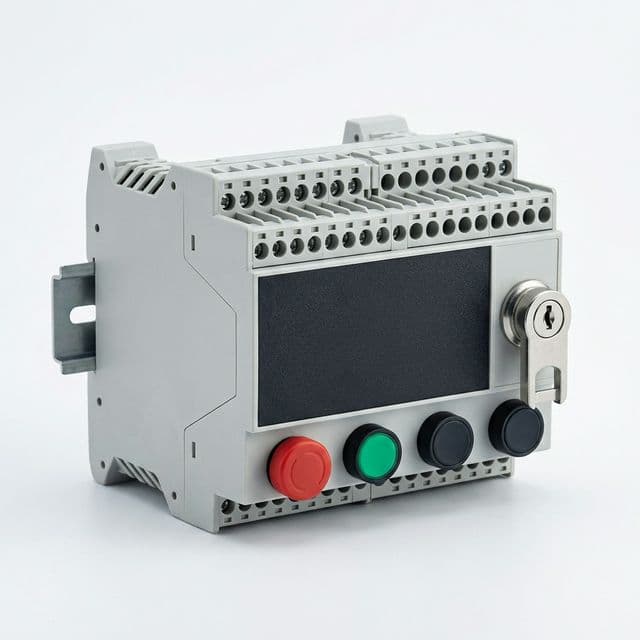
Safety relay for emergency stop circuits
STO-enabled drive for machinery safety
Safety relay for functional safety certification