Drive unit supplied in April 2027
Assumption: Supplier and OEM confirm PCM status.
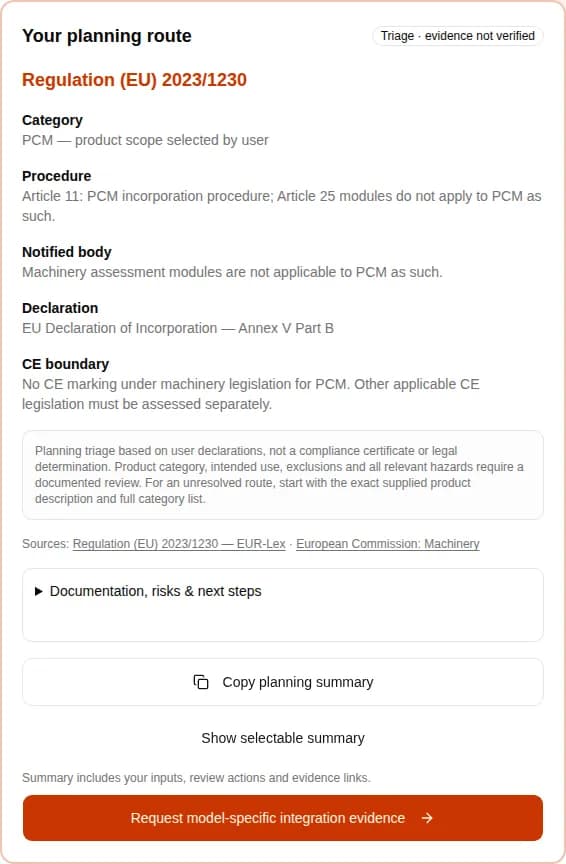
Review → result: Use Article 11; request Annex V B DoI and Annex XI assembly instructions. The final AMR needs a separate assessment.
 AMRDriveUnit
EU machinery transition · Evidence reviewed 21 October 2026
For AMR manufacturers and integrators: Directive 2006/42/EC remains the current machinery directive before 20 January 2027. Regulation (EU) 2023/1230 applies from that date. Enter the first EU placement date and product scope to plan your evidence request.
Request model-specific OEM evidenceRegulation (EU) 2023/1230
Sources: Regulation (EU) 2023/1230 — EUR-Lex · European Commission: Machinery
Annex IV Part B technical documentation + Annex XI assembly instructions
Article 11(7), Annex XI: digital instructions must be printable, downloadable and saveable; remain available for the expected lifetime and at least 10 years. A request at purchase requires free paper within one month.
Review relevant Annex III 1.1.9 / 1.2.1 corruption risks, including local service access and safety software. Connected interfaces add remote attack paths. For PCM, establish the relevant requirements and integration boundary.
This date must represent first EU market placement or first putting into service for own-use machinery. Order, manufacture, shipment and later commissioning dates can differ. Existing-stock and retrofit cases need separate review.
No universal fee or lead time is supported by the official sources. Testing effort, body scope, design maturity and availability require a project-specific estimate.
Example presets — category remains unconfirmed unless a safety-ML trigger is indicated:
As reviewed on 21 October 2026, Directive 2006/42/EC remains the pre-cutoff baseline. The tool identifies a planning path; the report explains the evidence needed to use that path.
| Conclusion | Practical consequence | Evidence |
|---|---|---|
| 20 January 2027 is the application cutoff | First placement / own-use event matters; manufacture date alone is insufficient. | Articles 3, 52, 54; Commission Machinery guidance |
| Product scope comes before modules | PCM follows an incorporation procedure; assess the final AMR separately. | Articles 3(10), 11; Annex V Part B, Annex XI |
| Category is not determined by payload | Review actual Annex I entries; not every heavy tugger or safety component is Part B. | Articles 6–7, 25; Annexes I–II |
| Self-evolving safety ML can trigger Part A | Confirm the safety function and points 5 / 6; compare B + C, H and G. | Annex I Part A; Article 25(2) |
| Connectivity increases review effort | Offline status does not remove relevant corruption risks; CRA scope is separate. | Annex III 1.1.9 / 1.2.1; CRA guidance |
Sources: European Commission: Machinery · Regulation (EU) 2023/1230 — EUR-Lex · European Commission: Cyber Resilience Act
“Current machinery directive” refers here to Directive 2006/42/EC for the pre-20-January-2027 baseline. “Machinery Directive 2023” refers to its successor, Regulation (EU) 2023/1230. The Regulation was published on 29 June 2023; its general mandatory application date is 20 January 2027.
| Situation | Review baseline | Evidence to retain |
|---|---|---|
| First EU placement before 20 January 2027 | Directive 2006/42/EC; do not replace it with Regulation-only paperwork. | Individual unit identification, placement event, applicable declaration. |
| First EU placement / first own use from 20 January 2027 | Regulation (EU) 2023/1230, subject to scope and transitional provisions. | Relevant event evidence, category review and updated conformity documentation. |
| Already lawfully placed before the cutoff | Article 52 protects further making available; no blanket renewal solely because of the date. | Evidence that the unit was actually placed, not merely manufactured or stored. |
| Existing machine modified in service | Separate modification assessment. A new purchase is not the only possible trigger. | Change specification, original intended use, risk assessment and safeguards. |
Sources: European Commission: Machinery · Regulation (EU) 2023/1230 — EUR-Lex
| Topic | Directive baseline | Regulation baseline |
|---|---|---|
| Assessment procedure | Article 12; Annex IV listed categories; Annexes VIII–X procedures. | Article 25; Annex I Parts A / B; modules depend on category and coverage. |
| PCM evidence | Article 13; Annex II 1.B DoI; Annex VII B file; Annex VI instructions. | Article 11; Annex V B DoI; Annex IV B documentation; Annex XI instructions. |
| Safety components | Definition Article 2(c); indicative Annex V list. | Definition Article 3(3); indicative Annex II list, including qualifying digital components. |
| Protection against corruption | Existing control-system safety requirements remain relevant. | Explicit Annex III 1.1.9 and control-system requirements under 1.2.1. |
| Digital instructions | Apply Directive instructions rules and current official application guidance. | Articles 10(7), 11(7); digital-delivery conditions and paper protections. |
| Modifications | Assess under Directive, official guidance and relevant national rules. | Definition Article 3(16); manufacturer duties under Article 18 if met. |
Sources: Directive 2006/42/EC — EUR-Lex · Regulation (EU) 2023/1230 — EUR-Lex
The category selector records your review; it does not perform a complete Annex search. If you cannot identify the exact entry and exclusions, leave it unconfirmed. Safety performance levels and vehicle mass do not replace that review.
| Product / category | Available procedure | Decision boundary |
|---|---|---|
| PCM | Article 11 incorporation procedure. | Article 25 modules are not the PCM procedure. |
| Annex I Part A | B + C; H; or G. | Notified body involved even when harmonised standards are applied. |
| Annex I Part B, complete qualifying coverage | A; B + C; H; or G. | Module A depends on complete applicable harmonised-standard / common-specification coverage. |
| Annex I Part B, incomplete coverage | B + C; H; or G. | A generic standards claim does not unlock Module A. |
| Machinery / related products outside Annex I | Module A under Article 25(4). | Risk assessment, technical documentation, verification and production control remain required. |
| Unknown category or uncertain scope | Unresolved: obtain product-specific review. | Do not infer notified-body exemption from missing information. |
Part A point 5 addresses qualifying self-evolving ML safety components. Point 6 concerns machinery embedding such systems, in respect of those systems. A navigation algorithm with a separate deterministic safety envelope is not automatically the same case.
Sources: Regulation (EU) 2023/1230 — EUR-Lex
Confirm whether the supplied assembly is almost machinery that cannot itself perform a specific application and is intended for incorporation (Article 3(10)). A standalone motor, an independently marketed safety component and a complete mobile robot can have different boundaries. Missing a battery or on-site connection alone does not settle PCM status.
| Evidence | Legal reference | Integration review |
|---|---|---|
| EU Declaration of Incorporation | Annex V Part B; Article 22 | Match manufacturer, unit identity and applied / fulfilled EHSRs. |
| Relevant technical documentation | Annex IV Part B; Article 11 | Confirm responsible party, risk assessment, verification and authority-response obligations; agree the integration data supplied. |
| Assembly instructions | Annex XI; Article 11(7) | Confirm load, speed, thermal, braking, mounting and interface limits for the selected model. |
| Machinery CE boundary | PCM incorporation procedure | No machinery CE marking for PCM; review other applicable CE legislation independently. |
| Safety function evidence | Relevant EHSRs and supplied instructions | Request applicable model-specific ratings, test scope, wiring and validation assumptions; do not infer PL/SIL from a diagram. |
Sources: Regulation (EU) 2023/1230 — EUR-Lex · Directive 2006/42/EC — EUR-Lex
Request the selected drive unit’s incorporation and assembly evidence| Reference family | Engineering purpose | Boundary / next check |
|---|---|---|
| EN ISO 3691-4 | Driverless industrial truck and system safety. | Check application scope, exact edition, OJ citation and restrictions under the applicable legal act. |
| EN ISO 13849-1 / IEC 62061 | Safety-related control-system design and validation framework. | Derive required safety performance from risk assessment; no universal PL d / SIL 3 promise. |
| EN / IEC 60204-1 | Electrical equipment of machinery. | Confirm applicable edition, scope and conformity evidence for the integrated machine. |
| IEC 62443 family | Industrial security methods and product / system requirements. | Can support engineering; not an automatic machinery or CRA conformity certificate. |
| Harmonised status under the Regulation | Requirement-specific presumption depends on legal citation. | Unknown until exact citation and coverage are checked. A Directive citation does not automatically transfer. |
This page does not assert that a named edition is currently harmonised under both acts. Keep a dated standards register and clause-to-EHSR mapping. Verify status again when the design and placement date are fixed.
Sources: European Commission: Machinery harmonised standards · European Commission: Machinery · Regulation (EU) 2023/1230 — EUR-Lex
Annex III 1.1.9 addresses corruption affecting safety-critical hardware, software and data, including relevant intervention evidence. The requirement is risk based; the text does not prescribe one universal architecture, DIP switch, cryptographic algorithm or IEC security level.
| Review | Timing / scope | Practical evidence |
|---|---|---|
| Machinery protection against corruption | Regulation baseline from 20 January 2027; relevant EHSRs apply to PCM too. | Safety software identity, access paths, intervention records, corruption and safe-state verification. |
| CRA reporting obligations | From 11 September 2026 for products / obligations in scope. | Determine scope, incident / vulnerability reporting responsibilities and process. |
| CRA main obligations | From 11 December 2027, subject to CRA transitional provisions. | Product-specific scope, lifecycle vulnerability handling and applicable assessment evidence. |
| Relationship between acts | Assess both; Article 9 is not a blanket CRA exemption. | Map overlapping requirements to evidence without assuming one declaration discharges every obligation. |
Sources: Regulation (EU) 2023/1230 — EUR-Lex · European Commission: Cyber Resilience Act · Regulation (EU) 2024/2847 — EUR-Lex
For the Regulation, Article 3(16) requires a physical or digital change after placement / first use that was not foreseen or planned by the manufacturer, affects safety through a new hazard or increased risk, and requires the specified protective-device / safety-control changes or stability / mechanical-strength measures. Article 18 imposes manufacturer duties when that test is met.
| Change | Evidence to compare | Conditional next step |
|---|---|---|
| Like-for-like drive replacement | Original specification, intended maintenance, unchanged interfaces and safeguards. | Record equivalence; a replacement alone does not establish substantial modification. |
| Increased speed or payload | New hazards, braking / stability margins, original planned envelope and required safeguards. | Apply the full test; if met, assess manufacturer duties for affected machinery. |
| Battery or wheelbase change | Stability, mechanical strength, energy / thermal hazards and original design assumptions. | Determine necessary measures before deciding the classification. |
| AI or firmware safety change | Safety responsibility, original planned behaviour, new risk and control-system changes. | Review modification and category separately; ordinary updates are not automatically substantial. |
Before 20 January 2027, review the Directive, current official application guidance and relevant national rules instead of applying Article 18 as the governing rule.
Sources: Regulation (EU) 2023/1230 — EUR-Lex · Directive 2006/42/EC — EUR-Lex · European Commission: Machinery
A planning result is mistaken for approval.
Keep scope assumptions and a named owner for category, EHSR and test-evidence review.
A generic audit budget or zero-fee claim drives procurement.
Fees and lead times are unknown here. Obtain scoped quotations; include engineering, tests, translation and change control even for internal assessment.
A PCM result is reused for the final robot or retrofit.
Separate the supplied assembly, completed machine and field modification. If unclear, collect the product description and ask the responsible conformity specialist.
This tool does not resolve road-use approval, explosive-atmosphere requirements, the full AI Act, workplace operation rules or all other applicable product legislation. No source here establishes a universal notified-body fee, audit queue, certified product performance or customer saving.
Sources: European Commission: Machinery · Regulation (EU) 2023/1230 — EUR-Lex
Illustrative examples, not customer projects or verified certification outcomes. Assumptions are explicit so you can see when the result changes.
Assumption: Supplier and OEM confirm PCM status.
Review → result: Use Article 11; request Annex V B DoI and Annex XI assembly instructions. The final AMR needs a separate assessment.
Assumption: The date is evidenced first EU placement, not manufacture.
Review → result: Use the Directive route and Annex IV review. Moving first placement to 20 January changes the legal baseline.
Assumption: The ML ensures a safety function and matches Part A point 6.
Review → result: Review B + C, H or G with an appropriately notified body. A navigation-only ML claim would need a different analysis.
Assumption: Payload is high; the full Annex I review has not been completed.
Review → result: Leave the category unresolved. If confirmed outside Annex I, Article 25(4) gives Module A; mass alone does not assign Part B.
Sources: Regulation (EU) 2023/1230 — EUR-Lex · Directive 2006/42/EC — EUR-Lex · European Commission: Machinery
As reviewed on 21 October 2026, Directive 2006/42/EC remains the baseline for machinery first placed on the EU market before 20 January 2027. Regulation (EU) 2023/1230 applies on a mandatory basis from 20 January 2027. Select the relevant event date in the tool; manufacturing or purchase dates alone do not decide the route.
Sources: European Commission: Machinery · Regulation (EU) 2023/1230 — EUR-Lex
The formal instrument is Regulation (EU) 2023/1230. “Machinery Directive 2023” is a common search phrase for the successor to Directive 2006/42/EC. A regulation applies directly; national workplace-safety and enforcement rules can still matter.
Sources: European Commission: Machinery
Establish first EU market placement for each unit, or first putting into service for machinery built for own use. Those events can differ from manufacture, order, shipment and commissioning. The tool uses the date you enter as that legal event, without verifying the supporting transaction evidence.
Sources: Regulation (EU) 2023/1230 — EUR-Lex · European Commission: Machinery
Article 52 preserves further making available of products lawfully placed under Directive 2006/42/EC before the cutoff. The date alone does not require blanket recertification of existing machinery. New units, imported used machinery first entering the EU, modifications and workplace duties need their own assessment.
Sources: Regulation (EU) 2023/1230 — EUR-Lex · European Commission: Machinery
First confirm the supplied assembly’s scope. If it is PCM under Article 3(10), the Regulation requires an EU Declaration of Incorporation (Annex V Part B), technical documentation (Annex IV Part B) and assembly instructions (Annex XI), rather than machinery CE marking. Other applicable CE legislation is assessed separately. Not every motor or drive automatically has PCM status.
Sources: Regulation (EU) 2023/1230 — EUR-Lex · Directive 2006/42/EC — EUR-Lex
Neither payload alone nor the broad label “safety component” determines the category. Match the exact product and intended use to the full Annex I list after the cutoff, or Directive Annex IV before it. Annex II is an indicative safety-component list, not an automatic assignment to Annex I Part B.
Sources: Regulation (EU) 2023/1230 — EUR-Lex · Directive 2006/42/EC — EUR-Lex
After the cutoff, Annex I Part A point 5 addresses self-evolving machine-learning safety components; point 6 addresses machinery embedding such systems, in respect of those systems. Article 25(2) offers B + C, H or G, with notified-body involvement. AI used only for navigation is not by itself this trigger; establish whether it ensures a safety function and review other category entries.
Sources: Regulation (EU) 2023/1230 — EUR-Lex
Under Article 25(4), machinery and related products outside Annex I use Module A. For Part B, Article 25(3) allows Module A only with qualifying harmonised standards or common specifications covering all relevant essential health and safety requirements. Part A requires a third-party route even when standards are applied. PCM follows Article 11 instead of Article 25 modules.
Sources: Regulation (EU) 2023/1230 — EUR-Lex
Articles 10(7) and 11(7) allow digital instructions subject to access, print, download and storage conditions, availability for the expected lifetime and at least ten years, and free paper within one month when requested at purchase. Article 10(7) still requires essential safety information on paper for intended or foreseeable non-professional use. PCM assembly instructions are in Annex XI. Check the destination language requirements.
Sources: Regulation (EU) 2023/1230 — EUR-Lex
No network connection does not establish an exemption from protection against corruption. Local service interfaces and safety software can still be relevant. Separately check whether the product falls within the CRA. CRA reporting applies from 11 September 2026 and its main obligations from 11 December 2027. Article 9 of the Machinery Regulation does not grant a blanket CRA exemption.
Sources: Regulation (EU) 2023/1230 — EUR-Lex · European Commission: Cyber Resilience Act · Regulation (EU) 2024/2847 — EUR-Lex
Apply the full Article 3(16) test: a physical or digital change after placement or putting into service, not foreseen or planned by the manufacturer, creates a new hazard or increases risk and requires the specified additional protective-device/control changes or stability/mechanical-strength measures. Article 18 manufacturer duties follow when that test is met. A replacement, firmware update or retrofit checkbox alone does not settle it.
Sources: Regulation (EU) 2023/1230 — EUR-Lex
No universal fee or turnaround is established by these official sources. Request a written quotation for the exact category, procedure, test evidence and design maturity. Confirm the body’s current notification scope, applicable standard editions, any citation restrictions and supplier-specific safety performance. The tool does not calculate a compliance score or verify certification.
Sources: European Commission: Machinery · European Commission: Machinery harmonised standards
Published by AMRDriveUnit. Published . Evidence reviewed .
The checker compares one event date with 20 January 2027, then branches on the user-selected scope and category. It never validates legal placement evidence, full Annex classification, supplier tests or actual EHSR coverage. Recheck current consolidated legislation and official guidance for the project date.
Application date, transition, market placement and notified bodies.
Articles 3, 10, 11, 18, 25, 52, 54; Annexes I, III, IV, V, X and XI. Consult the consolidated text and linked authentic OJ acts.
Articles 12–13; Annexes II, IV, VI–X for the pre-cutoff route.
Reporting obligations from 11 September 2026; main obligations from 11 December 2027. Scope must be assessed separately.
CRA scope, vulnerability handling, reporting and transitional provisions.
Check exact editions, restrictions and withdrawal dates. Directive citations do not establish Regulation coverage.
Unknowns requiring project evidence: exact category, exclusions, harmonised-standard status and coverage, test scope, model-specific safety capability, notified-body availability, fees and lead time. No automated result updates the evidence-review date.
Review owner: AMRDriveUnit. Review again by 19 January 2027 and after relevant legislation or official guidance changes; otherwise review at least every six months.
Send the selected model, product boundary, placement date, intended use and open questions. Request available declarations, assembly instructions and model-specific safety evidence for your OEM review.